How the 3D Print Cost & Price Calculator Works
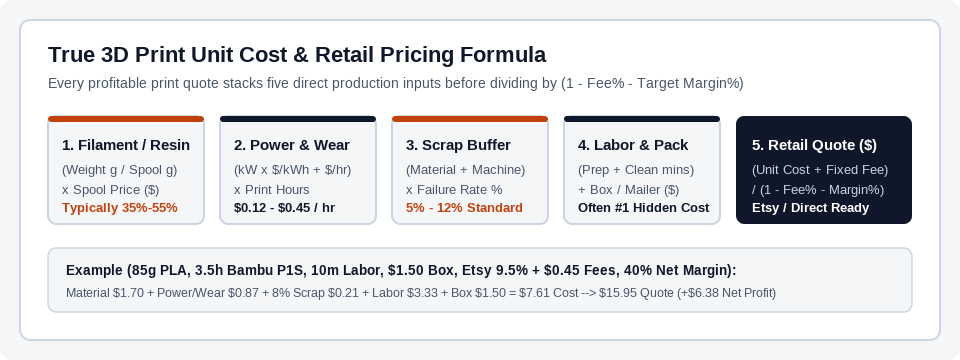
True 3D print unit cost equals the sum of filament material, electric power, hourly printer depreciation, a failed-print scrap buffer, hands-on shop labor, and shipping packaging. Most hobby calculators multiply gram weight by spool price and stop there, which underprices commercial jobs by 45% to 70% once nozzle wear, bed-heating electricity, support removal, and marketplace commissions take their cut.
You can use this 3D print cost calculator in two ways right in your browser:
- Manual Slicer Entry: Type the exact filament weight in grams and print duration in hours reported by Bambu Studio, OrcaSlicer, PrusaSlicer, or UltiMaker Cura.
- Local STL or 3MF Drag-and-Drop: Drop a
.stlor.3mfmesh onto the workbench above. Your browser computes the exact signed tetrahedron volume in cubic centimeters (cm³), estimates outer wall shell volume plus interior infill percentage, and multiplies by your chosen filament density (1.24 g/cm³for PLA,1.27 g/cm³for PETG,1.04 g/cm³for ABS) without uploading your CAD file to any server. Need to inspect XYZ bounding dimensions or overhang geometry first? Open the Online STL & 3MF Viewer or convert multi-plate files in the 3MF to STL Converter.
3D Printer Power Draw & Hourly Machine Depreciation Benchmarks
Desktop FDM 3D printers consume between 65 W and 150 W of continuous wall power during active printing and cost $0.08 to $0.35 per hour in realistic hardware depreciation and wear parts. While peak bed warm-up draws 300 W to 1,000 W for the first two to four minutes, steady-state printing averages much lower wattage depending on chamber enclosure and bed temperature.
| 3D Printer Model | Avg PLA/PETG Draw | Hardware Cost | Service Life | Depreciation + Wear |
|---|---|---|---|---|
| Bambu Lab A1 Mini | 65 W | $199 | 2,500 hrs | $0.08 / hr |
| Creality Ender 3 V3 | 105 W | $199 | 2,000 hrs | $0.10 / hr |
| Creality K1C (Enclosed) | 135 W | $499 | 2,500 hrs | $0.20 / hr |
| Bambu Lab P1S | 110 W | $699 | 3,000 hrs | $0.23 / hr |
| Prusa MK4S | 95 W | $999 | 4,000 hrs | $0.25 / hr |
| Bambu Lab X1 Carbon | 120 W | $1,199 | 3,500 hrs | $0.34 / hr |
Hourly machine wear covers both capital replacement over 2,000 to 4,000 print hours and consumable maintenance items: hardened steel nozzles ($15 to $35 every 600 hours), textured PEI build plates ($25 every 800 hours), PTFE tubing, and belt tensioning. If you run photopolymer vat machines with FEP release films and mono LCD screens, switch to our dedicated Resin 3D Print Cost Calculator.
Etsy, eBay & Direct Client 3D Printing Price Formulas
To preserve your target net profit margin on marketplaces, you must divide your production cost plus fixed order fees by 1 - Fee% - TargetMargin% rather than multiplying cost by a flat percentage. Adding 40% on top of unit cost and then paying Etsy fees leaves you with less than 24% actual take-home margin because platform commissions are deducted from the final gross sale price.
- Standard Etsy Shop Fees: Etsy charges a
6.5%transaction fee on the item total plus shipping,3.0% + $0.25for US Etsy Payments processing, and a$0.20listing renewal fee—totaling9.5% + $0.45per order. - Etsy Offsite Ads Orders: When a buyer clicks an Etsy Offsite Ad on Google or Instagram, Etsy adds a
15%attribution fee (or12%for shops exceeding $10,000/year), pushing total platform deductions to24.5% + $0.45. Testing your quote under the Etsy + Offsite Ad preset guarantees you never lose money on attributed orders. - Direct Client & Batch Quotes: For B2B prototypes or local commission runs, card processors like Stripe and Shopify charge
2.9% + $0.30. Read our full breakdown in How to Price 3D Prints for Profit and check material yield differences in PLA vs PETG Filament Density & Cost.
Why Hands-On Labor & Scrap Buffers Make or Break Print Farms
Ten minutes of hands-on plate clearing, brim deburring, support removal, and box packing at a modest $20/hour shop rate adds $3.33 to every single order—nearly double the $1.70 filament cost of an 85-gram PLA print. Ignoring prep and packing labor means you are merely trading filament at cost while working for free.
Adding a 5% to 12% scrap and failure buffer protects your shop ledger against tangled spools, wet PETG stringing, tall-part bed detachment, and multi-color AMS purge waste. Simple single-color functional brackets typically need a 5% buffer, whereas tall organic cosplay props, silk PLA articulated models, or multi-material prints warrant 12% to 20%.